

Traduzione, traducción, tradução
Translation
Italian, Portuguese and Spanish translations by a NAATI-certified translator
Select translations available to order instantly
Contact TradTrans for all other translations
Words translated
Customers served
Years meeting clients needs
Satisfied clients
Find out about…
NAATI
certified
translations
Driver
licence
translations
Police
check
translations
Standard
certificate
translations
Translations
for visas and
immigration
Translations for skills
assessments
Translations
for passport
applications
Extract
translations
Traduzioni dall’italiano all’inglese
Traducciones de español a inglés
Traduções do português para o inglês
Do you need a Colombian driver licence translated? An Italian ID card? A Brazilian police check?
If you need an Italian, Spanish or Portuguese translation by a NAATI certified translator, you’ve come to the right place. TradTrans can translate your documents into English and will stamp and certify the translations, meeting all Australian requirements in the process.
TradTrans will translate all sorts of documents, up to and including books, but if you’re specifically interested in NAATI certified translations of certificates, driver licences or police checks check out the detailed sections for more info.
What sort of documents do you have?
- Standard single page certificates (starting at $55 AUD per page)
- Non-standard documents (starting at $0.25 AUD per word)
What do others have to say?
Check out the independent Google reviews online to see what other customers think about TradTrans.
5.0 ★★★★★ (19) on G o o g l e


NAATI certified translations
from Italian, Spanish and Portuguese to English

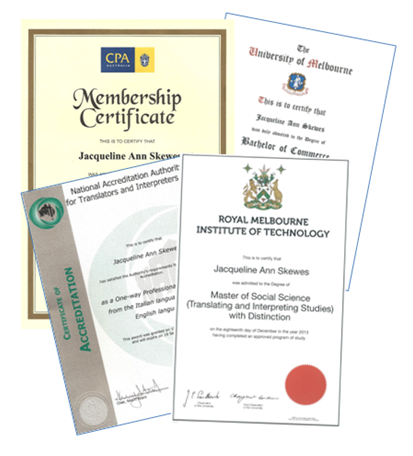
A “NAATI certified translation” is one that has been done by a NAATI Certified Translator who certifies and stamps their translation. This guarantee of quality generally reflects the following features:
- The translator has passed the NAATI Certified Translator test and has remained current by recertifying their credentials every three years. The translator’s credentials can be confirmed online using NAATI’s Verify Credential function and entering their NAATI number.
- The translator’s NAATI stamp containing their name and NAATI number is affixed to the translation – either the NAATI digital stamp with a QR code or the NAATI physical stamp with a handwritten signature. See more about NAATI stamps here.
- And finally, the translator adds a certification statement such as “this is a true and accurate translation of the Italian text on an electronic copy of the attached document. It has been translated to the best of my knowledge and ability on today’s date”. The exact wording may vary, but it is usually worded in accordance with the AUSIT Recommended Best Practices for the Translation of Official and Legal Documents.
NAATI has given Certified Translators other names in the past. Up until January 2018 they were known as Accredited Professional Translators, and before that they were called Level 3 Advanced Translators. If you need an Accredited Translator or Level 3 Translator, they are called Certified Translators today. In some other language combinations, the translator may only be awarded a Recognised Practising Translator credential, but for Italian, Portuguese and Spanish translations it must be a Certified Translator.
All Italian, Spanish and Portuguese translations ordered through TradTrans will be done by a NAATI Certified Translator, guaranteed! This means that you will always know exactly who has done the work for you.TradTrans can provide NAATI certified translations of:
- Personal ID documents (driver licences, ID cards, passports, police checks, birth/baptism/marriage/death, residency permits)
- Financial evidence (payslips, tax returns, bank statements, superannuation contributions)
- Education history (degrees, diplomas, academic transcripts, certificates of attendance, course syllabus)
- Employment history (references, letters of offer, employment contracts, military service)
- Legal contracts (real estate buy/sell/lease, power of attorney, last will and testament)
- Court proceedings (divorce, child custody, criminal record)
- Medical background (medical certificates, medical reports, vaccination records)
- Utility bills (electricity, telephone, internet)
- Relationship evidence (SMS messages, personal references)
- Business information (company extracts, annual reports, financial statements, articles of association, company statute, company constitution)
Standard certificate translations
from Italian, Spanish and Portuguese to English
What is a ‘standard’ certificate?
NAATI certified translations of most common certificates in Italian, Spanish and Portuguese will be charged at $55 AUD per page. This rate usually applies for translations of single page certificates of 200 words or less. Example categories include:
- Driver licence
- Police check
- Birth certificate
- Baptism certificate
- Marriage certificate
- Death certificate
- National ID card
- Passport
- Residency permit
- Degrees (single page testamur)
- Certificate of attendance
Please note, the certificate rate does not necessarily apply to handwritten certificates, multi-page certificates, non-standard formats or certificates from last century. If you have one of these contact TradTrans for a quote and you might like to consider getting an extract translation instead (check first if this will be suitable for your purpose).
‘Non-standard’ certificates or text documents
Some documents for translation can be very personal, detailed or long, and this type of text would generally be charged at $0.25 AUD per word with a $55 minimum. Examples include:
- References from previous employers
- Joint bank account statements
- Billing accounts in joint names
- Statutory declarations from third parties
- Academic transcripts (showing subjects and grades)
- Letter/statement from your overseas Education Institution
Translations for visas and immigration
from Italian, Spanish and Portuguese to English
NAATI certified translations by TradTrans from Italian, Spanish and Portuguese translations will always meet immigration requirements, with the translations being stamped, signed and certified according to the standards of the Department of Home Affairs. These requirements change regularly, but you can trust TradTrans to stay on top of things, so you don’t have to.
Translate
https://immi.homeaffairs.gov.au/citizenship/become-a-citizen/permanent-resident#HowTo > Prepare your documents > Show steps > Online application “See how” > Translate “See how”
Provide an English translation for all documents that are not in English.
You need to provide the:
– original document
– English translation.
If you do not provide English translations of non-English documents, this may delay your application.
In Australia, you should use a translator accredited by the National Accreditation Authority for Translators and Interpreters (NAATI).
Translators outside Australia do not have to be NAATI accredited.
Every translation should include the translator’s:
– full name
– address and telephone number
– qualifications and experience in the language they are translating.
Provide all translator details in English.
Document translation requirements
https://immi.homeaffairs.gov.au/help-text/eplus/Pages/elp-h1470.aspx#doco_trans
Documents in languages other than English must be accompanied by an English translation. If you are in Australia when applying, use translators accredited by the National Accreditation Authority of Translators and Interpreters (NAATI). For more information, see NAATI.
If you are outside Australia when applying, the English translation must be completed by a qualified translator and must be endorsed by the translator with their full name, address, telephone number, and details of their qualifications and experience in the language being translated.
Online applications
https://immi.homeaffairs.gov.au/help-support/applying-online-or-on-paper/online#tab-content-1 > Attach documents to your application > Document size and format “Details”
Document size and format
Digital photographs should be between 70KB and 3.5MB each. Other documents can be up to 5MB each.
We accept the following file formats:.pdf*
* The ImmiAccount system does not accept encrypted or secured PDF files.
If you are unable to attach document, check that it is not encrypted. This often occurs with documents downloaded directly from the website. You can print and scan a new copy of the document and upload it.
If you are applying for an Australian visa or citizenship, you’ll need translations done by a NAATI Certified Translator. All certificates and documents in Italian, Portuguese and Spanish must be translated into English for your immigration application.
Translations for passport applications
If you are applying for an Australian passport, you’ll need translations done by a NAATI Certified Translator. All certificates and documents in Italian, Portuguese and Spanish must be translated into English for your immigration application, unless they are multilingual documents where one of those languages is English.
Traditionally the Australian Passport Office has always required FULL translations, and won’t accept partial or extract translations. That guidance was removed from their website in 2025.
Help with translations
https://www.passports.gov.au/help/interpreting-and-translation
If your documents aren’t in English, you’ll need to get them translated in full and stamped by an accredited translator before you show them to us.
If you’re in Australia, the National Accreditation Authority for Translators and Interpreters (NAATI) can help you find a translator in your area.
We accept translated documents from other government agencies who use NAATI translators. These translations must be on the agency’s letterhead. They include:
– TIS National – the Department of Home Affairs
– Multicultural NSW Language Services – New South Wales
– Interpreting and Translating Services NT – Northern Territory
– Interpreting and Translating Centre – South Australia.
If you’re overseas, contact your nearest Australian embassy or consulate(Opens in a new tab/window). They’ll give you a list of approved translation services in your country.
Your local embassy or consulate will check any translated documents. They’ll do this at no extra charge when you lodge your passport application.
You can use your translated documents again for any future passport applications. You won’t need new translations made in Australia.
How about an extract translation?
Personal email from the Australian Passport Office, 23 September 2021
We do not accept extract translations.
Identity documents
https://www.passports.gov.au/help/identity-documents-you-need
All of your documents must be in English or translated in full by an approved translation service.
The Australian Passport Office is one arm of the Department of Foreign Affairs and Trade (DFAT). NAATI certified Italian, Portuguese and Spanish translations from TradTrans will always meet DFAT requirements, with the translations being stamped, signed and certified according to departmental instructions. And the translator’s signature and seal are already on file with DFAT to fast-track any legalisation/apostille process! Please note that DFAT requirements are different to the ones used for immigration, but you can trust TradTrans to stay on top of things so you don’t have to.
Extract translations
from Italian, Spanish and Portuguese to English
Unless otherwise specified TradTrans will provide full translations. However many documents can also be translated in a format known as an ‘extract’ translation. This means that the important information is extracted from the certificate and laid out in a way that government departments can use to quickly and easily find the information they need. In contrast to a ‘full’ translation the layout and design are quite different to the source document, but all the important information is still included. The difference is that it is formatted in a way that is easy for Australian government departments to follow, and eliminates unnecessary extraneous information.
If you don’t require a full translation, ask for an extract translation instead. Because it is a standard format document it allows for a faster translation, saving you both time and money. Extract translations are charged at a flat rate per certificate, even if it is a multi-page certificate. Please note, it is your responsibility to ascertain whether the end user will accept an extract translation or not. Responses vary depending on which government department or authority you are dealing with. For instance the Department of Home Affairs (immigration) is traditionally considered to be in favour of extract translations, whereas the Australian Passport Office (DFAT) usually requests a full translation.
Documents that are well suited to extract translations include: Payslips, tax returns, bank statements, pension contributions, residential lease contracts, real estate contracts to buy/sell property, vaccination records, and utility bills (electricity, telephone, internet).
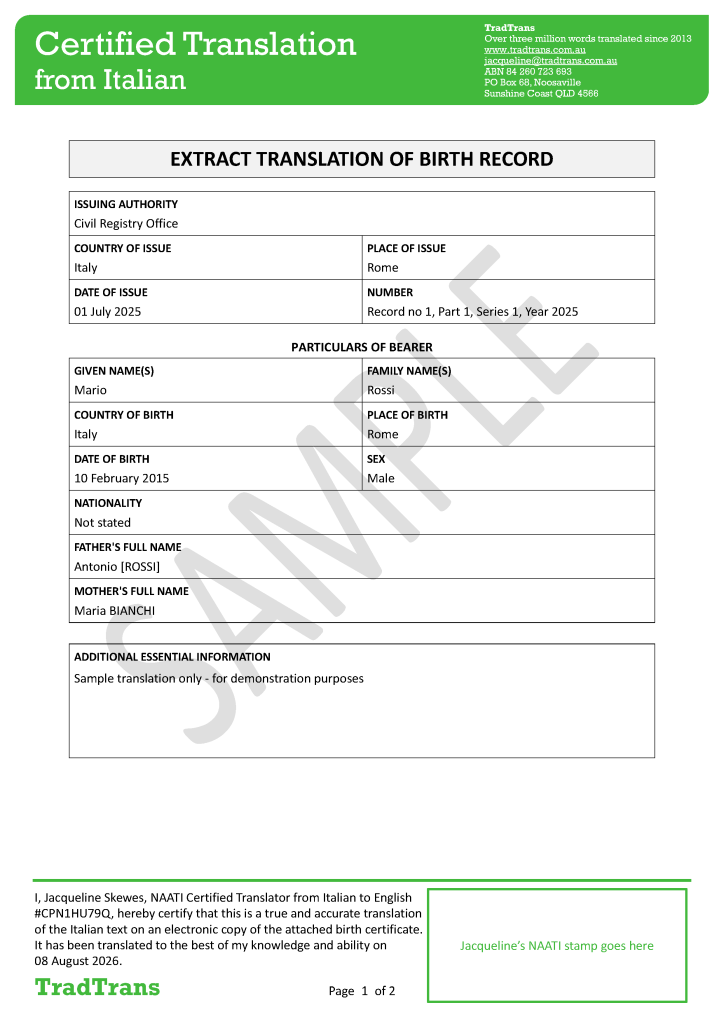
Type of information included in an extract translation:
- Names
- Dates
- Places
- Signatory/issuing authority
- Reference numbers
- Relevant additional information
Type of information excluded from an extract translation:
- Stamp duty
- Local legislative information
- Terms and conditions
- Irrelevant additional information
Select extract translations available to order online instantly